Sitemap
A list of all the posts and pages found on the site. For you robots out there is an XML version available for digesting as well.
Pages
Posts
Future Blog Post
Published:
This post will show up by default. To disable scheduling of future posts, edit config.yml and set future: false.
Blog Post number 4
Published:
This is a sample blog post. Lorem ipsum I can’t remember the rest of lorem ipsum and don’t have an internet connection right now. Testing testing testing this blog post. Blog posts are cool.
Blog Post number 3
Published:
This is a sample blog post. Lorem ipsum I can’t remember the rest of lorem ipsum and don’t have an internet connection right now. Testing testing testing this blog post. Blog posts are cool.
Blog Post number 2
Published:
This is a sample blog post. Lorem ipsum I can’t remember the rest of lorem ipsum and don’t have an internet connection right now. Testing testing testing this blog post. Blog posts are cool.
Blog Post number 1
Published:
This is a sample blog post. Lorem ipsum I can’t remember the rest of lorem ipsum and don’t have an internet connection right now. Testing testing testing this blog post. Blog posts are cool.
portfolio
Portfolio item number 1
Short description of portfolio item number 1
Portfolio item number 2
Short description of portfolio item number 2
publications
Printing the Polyphorm: Using 3D Printing to Manufacture Biologically Inspired Rhizomatic Structures
Published in eScholarship, 2021
We present a pipeline for converting voxelized data generated by the Monte Carlo Physarum Machine (MCPM) based Polyphorm data visualization software into a mesh that can then be 3D printed. This reconstruction technique is based on the Marching Cubes algorithm paired with a suite of pre and post processing tools. Our process can be used to create both biomimetic structures and computational art, and can be tuned to create various visual effects based on the desired stylistic output.
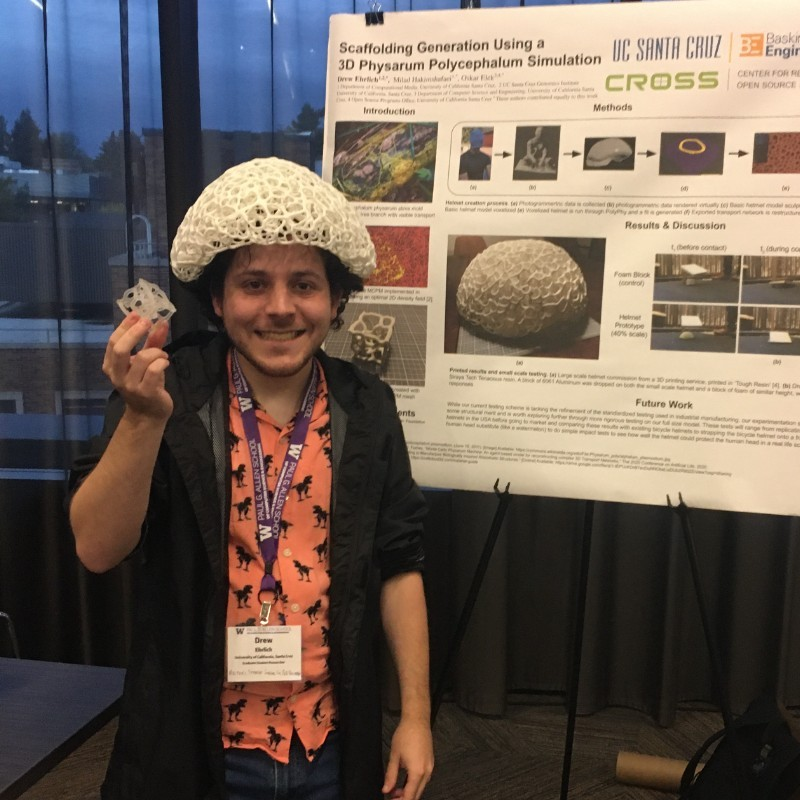
Scaffolding Generation using a 3D Physarum Polycephalum Simulation
Published in Proceedings of the 7th Annual ACM Symposium on Computational Fabrication, 2022
In this demo, we present a novel technique for defining topologically optimal scaffoldings for 3D printed objects using a Monte Carlo algorithm based on the foraging behavior of the Physarum polycephalum slime mold. As a case study, we have created a biologically inspired bicycle helmet using this technique that is designed to be effective in resisting impacts. We have created a prototype of this helmet and propose further studies that measure the effectiveness and validity of the design.
Cloud-controlled microscopy enables remote project-based biology education in underserved Latinx communities
Published in Heliyon, 2022
Project-based learning (PBL) has long been recognized as an effective way to teach complex biology concepts. However, not all institutions have the resources to facilitate effective project-based coursework for students. We have developed a framework for facilitating PBL using remote-controlled internet-connected microscopes. Through this approach, one lab facility can host an experiment for many students around the world simultaneously. Experiments on this platform can be run on long timescales and with materials that are typically unavailable to high school classrooms. This allows students to perform novel research projects rather than just repeating standard classroom experiments. To investigate the impact of this program, we designed and ran six user studies with students worldwide. All experiments were hosted in Santa Cruz and San Francisco, California, with observations and decisions made remotely by the students using their personal computers and cellphones. In surveys gathered after the experiments, students reported increased excitement for science and a greater desire to pursue a career in STEM. This framework represents a novel, scalable, and effective PBL approach that has the potential to democratize biology and STEM education around the world.
Creativity and Consistency in Musical Perception of Tangible Objects
Published in UCSC Technical Reports, 2023
Interacting with tangible objects can enhance our immersion in and the understanding of the experience of music. Associating tactile properties with sounds is an inherently creative process, but we lack a quantitative perceptual basis for these associations. A better understanding of this process of creative association can open new avenues for music appreciation or enhanced tangible musical experiences. When presented with a collection of objects and a collection of music, we found that study participants often associated specific objects with specific songs in consistent ways, while still using various creative ways to make these associations. Their explanations for the matchings identified possible salient perceptual features present in these pairings. Along with the results of our study, we offer a categorization of perceptual relations that can help us design meaningful physical representations of music in the future. With these understandings, we provide a basis for a new aspect of creativity research in music perception of tangible objects.
Physicalizing Virtual Models Created by Physarum Polycephalum 3D Simulation
Published in eScholarship, 2023
Abstract: This thesis presents a pipeline for creating visually compelling bio-inspired versions of triangle meshes that can be 3D printed using consumer hardware. The process to make these models uses the simulation software PolyPhy, whose behavior is governed by an algorithm that mimics the optimal foraging behavior of the Physarum polycephalum slime mold. The structures created with this technique can both serve as computational art and also lay the foundations creating novel infill structures for filament based 3D printing.
PolyPhy: Open Source Generator for 3D Printed Bio-inspired Objects
Published in Proceedings of the 8th ACM Symposium on Computational Fabrication, 2023
In this demo, we present an open source methodology for turning triangle meshes into biologically inspired 3D printable objects using an algorithm based on the behavior of the Physarum polycephalum slime mold. Users can import watertight 3D models and have full control of the simulation, allowing for granular control over the density and weight of the resulting network. This is the first open source tool to use this technique that is intended for public consumption and use.
Internet-connected cortical organoids for project-based stem cell and neuroscience education
Published in eNeuro, 2023
Abstract: The introduction of Internet-connected technologies to the classroom has the potential to revolutionize STEM education by allowing students to perform experiments in complex models that are unattainable in traditional teaching laboratories. By connecting laboratory equipment to the cloud, we introduce students to experimentation in pluripotent stem cell (PSC)-derived cortical organoids in two different settings: using microscopy to monitor organoid growth in an introductory tissue culture course and using high-density (HD) multielectrode arrays (MEAs) to perform neuronal stimulation and recording in an advanced neuroscience mathematics course. We demonstrate that this approach develops interest in stem cell and neuroscience in the students of both courses. All together, we propose cloud technologies as an effective and scalable approach for complex project-based university training.
Multimodal evaluation of network activity and optogenetic interventions in human hippocampal slices
Published in Nature Neuroscience, 2024
Seizures are made up of the coordinated activity of networks of neurons, suggesting that control of neurons in the pathologic circuits of epilepsy could allow for control of the disease. Optogenetics has been effective at stopping seizure-like activity in non-human disease models by increasing inhibitory tone or decreasing excitation, although this effect has not been shown in human brain tissue. Many of the genetic means for achieving channelrhodopsin expression in non-human models are not possible in humans, and vector-mediated methods are susceptible to species-specific tropism that may affect translational potential. Here we demonstrate adeno-associated virus–mediated, optogenetic reductions in network firing rates of human hippocampal slices recorded on high-density microelectrode arrays under several hyperactivity-provoking conditions. This platform can serve to bridge the gap between human and animal studies by exploring genetic interventions on network activity in human brain tissue.
Designing Tangible Devices and Interfaces for Closing Institutional Resource Gaps in Neuroscience
Published in Nature Neuroscience, 2025
Scientific laboratories are full of tangible and interactive interfaces and devices. However, design principles for the creation of these systems are either seen as industry secrets by scientific manufacturing companies or are too decentralized to be easily collected. The rise of the open science and open hardware movements has made creating tangible devices for the laboratory more accessible than ever, but research on design methods for their creation is not nearly as approachable. This leads to a gap between the institutions that have the resources to purchase professionally designed tools and those that either have to settle for running less effective laboratories or try and devise effective design methods for creating these tangible tools themselves. My research seeks to help close this gap by exploring methods for doing user-centered tangible hardware design research with laboratory scientists and creating some tangible interactive tools and interfaces for use in scientific laboratories.
Microscope Upcycling: Transforming legacy microscopes into automated cloud-integrated imaging systems
Published in HardwareX, 2025
Computerized microscopes improve repeatability, throughput, antisepsis, data analysis and data sharing in the biological laboratory, but these machines are cost-prohibitive in most academic environments. This is a barrier into collecting the large and consistent datasets required for machine learning analyses of microscopy data. We demonstrate hardware modifications and software to bring the features of modern computerized microscopes to decades-old legacy laboratory inverted microscopes. We demonstrate automation of X-Y positioning, focus stacking, image acquisition and image storage.
Microfluidic Topography Biases Neural Organoid Morphogenesis
Published in 2025 47th Annual International Conference of the IEEE Engineering in Medicine and Biology Society (EMBC), 2025
This study highlights how inherent micro-scale surface topographies can occur in microfluidic chips based on their fabrication modalities and how these surface topographies can bias organoid morphogenesis. Human cortical organoids were cultured and seeded into micro-wells with varying surface topographies for 21 days and were continuously recorded with the use of an in-incubator microscope. Afterwards, organoid morphology was tracked using computer vision and analyzed with a morphological data processing pipeline. Scanning electron microscopy and optical profilometry were used to analyze the topography of the micro-wells. A link between microfluidic surface topography and organoid morphogenesis was demonstrated.
A feedback-driven brain organoid platform enables automated maintenance and high-resolution neural activity monitoring
Published in Internet of Things, 2025
The analysis of tissue cultures requires a sophisticated integration and coordination of multiple technologies for monitoring and measuring. We have developed an automated research platform enabling independent devices to achieve collaborative objectives for feedback-driven cell culture studies. Our approach enables continuous, communicative, non-invasive interactions within an Internet of Things (IoT) architecture among various sensing and actuation devices, achieving precisely timed control of in vitro biological experiments. The framework integrates microfluidics, electrophysiology, and imaging devices to maintain cerebral cortex organoids while measuring their neuronal activity. The organoids are cultured in custom, 3D-printed chambers affixed to commercial microelectrode arrays. Periodic feeding is achieved using programmable microfluidic pumps. We developed a computer vision fluid volume estimator used as feedback to rectify deviations in microfluidic perfusion during media feeding/aspiration cycles. We validated the system with a set of 7-day studies of mouse cerebral cortex organoids, comparing manual and automated protocols. It was shown that the automated protocols maintained robust neural activity throughout the experiment while enabling hourly electrophysiology recordings during the experiments. The median firing rates of neural units increased for each sample, and dynamic patterns of organoid firing rates were revealed by high-frequency recordings. Surprisingly, feeding did not affect the firing rate. Furthermore, media exchange during a recording did not show acute effects on firing rate, enabling the use of this automated platform for reagent screening studies.
Incubator-Free Organoid Culture in a Sealed Recirculatory System
Published in BioRxiv, 2025
Organoids are powerful tools for studying development and disease, offering realistic organ-like human and animal tissues and facilitating experimental observation compared to live animal models. However, traditional organoid culture methods require a humidified incubator. This requirement complicates culture due to evaporative losses and restricted access to instrumentation, hindering the potential of organoids as physiologically accurate models easily subjected to detailed experimental observation. We introduce a compact, automated, sealed, incubator-free recirculatory organoid culture platform that replaces the air-liquid interface with a nonporous polymer gas exchanger and a liquid-phase gas buffer. This design prevents evaporation and stabilizes oxygen, pH, and osmolarity without feedback control. It enables single-actuator media exchange, simplifying automation. Dispensing with the incubator, we improve access for instruments such as live cell microscopes. We demonstrate compatibility with continuous multi-week live imaging of vascular organoids and show that brain organoids in this system maintain metabolic viability, structural fidelity, and electrophysiological activity comparable to traditional shaker-based cultures in an incubator.
Cloud-Connected Pluripotent Stem Cell Platform Enhances Scientific Identity in Underrepresented Students
Published in BioRxiv, 2026
Stem cell research offers unique opportunities for authentic scientific engagement, yet infrastructure requirements have confined participation to elite institutions, perpetuating workforce disparities. We developed an integrated framework combining engineered biology, cloud-connected microscopy, and validated psychometric assessment to make pluripotent stem cell (PSC) experimentation widely accessible. The framework comprises three components: a doxycycline-inducible NGN2 mouse embryonic stem cell line for rapid neuronal specification, low-cost cloud microscopy for remote observation, and the validated Stem Cell Research Identity Scale (SCRIS) for quantifying educational outcomes. Implementation across a Title I high school and urban community college demonstrated significant increases in scientific identity. Students using differentiating PSCs showed broader science identity development than those using neuroblastoma cells, particularly in competence, research readiness, and recognition. High school students showed enhanced research competence gains compared to community college students despite equivalent intervention duration. Demographic analyses revealed enhanced effectiveness for Hispanic and first-generation college students. This framework provides a scalable model for broadening participation in advanced biomedical research.
A Modular In-Incubator Microscope for Longitudinal Live Cell Microscopy
Published in BioRxiv, 2026
Longitudinal live cell imaging is valuable for characterizing dynamic morphological and phenotypic changes in biological systems. However, conventional approaches rely on manual microscope operation, which is labor-intensive, limits imaging frequency, and disrupts the cellular environment. These constraints reduce scalability, increase experimental variability, and restrict both the duration and temporal resolution of continuous imaging. Although automated imaging platforms partially address these limitations, existing solutions are often constrained by the cost, footprint, and inflexibility of in-incubator microscopes or stage-top incubators. Here, we present an automated in-incubator epifluorescence microscope designed for long-term operation. The system features a modular architecture with optional multi-fluorescence imaging, automated plate scanning, configurable light sources, and compatibility with multiple plate formats, including integration with fluidic automation devices. By positioning the light sources and control electronics outside the incubator, the platform improves thermal stability and long-term operational reliability. This approach enables continuous, high-frequency imaging over extended durations, providing a source of rich data for quantifying time-dependent tissue phenotypes, morphological remodeling, and transient biological processes.
talks
teaching
Teaching experience 1
Undergraduate course, University 1, Department, 2014
This is a description of a teaching experience. You can use markdown like any other post.
Teaching experience 2
Workshop, University 1, Department, 2015
This is a description of a teaching experience. You can use markdown like any other post.